TRAINS(hydraulics)

HYDRAULIC RAILWAY SYSTEM

*All of the weight of the train is sustained by the hydraulic fluid eliminating the use of wheels.
*Does not consumes energy for flotation (it is a closed sealed hydraulic system).
*It works with extremely low hydraulic pressure, due the distribution of the fluid In a great contact surface. Approximately 142 psi (10kgf/cm2).
*The train slides with insignificant friction and abrasion.
*In parallel to the chinese Maglev that floats under magnetic repulsion, this system floats under hydraulic fluid, but does not consumes energy for its flotation and is extremely simple, allowing smaller production costs than the common railway system.

***New, non-obvious, useful (PCT/OMPI 2012).

HOW IT WORKS
1)The basis of sustaining are inside the trails.

2)The basis, in pairs, slides through the trails.

3)Each sustaining bases possess two fluid chambers, upper and lower.

4)The chambers are one over the other, in contrary position.

5)All of the train weight is over fluid reservoirs, that are located over the sustaining basis.

6)The reservoirs fluid pressure is transfered to the chambers by hydraulic hoses.

7)The lower chamber possess a larger opening contact area with the trail, than the upper chamber, making with all the set float and equalize inside the trails.

* The flow will be solved for a sealing system similar to the segmented rings system of the pistons of inner combustion engines, but without subdue to the high temperatures.

*Side tabs, similar to pulleys, maintain the train centered.

Observation: as the main idea is to propose the solution for the FRICTION, the biggest of the transport troubles, aren’t considered here systems of traction, suspension, brakes, etc.

ADVANTAGES
*Extreme simplicity.

*Low hydraulic pressure.

*Very low fuel consumption.

*The production cost is the same or ever cheaper than traditional system.

*Elimination of the friction and the abrasion caused by the mechanical parts attrition.

*It will possess great efficiency, durability and reduced maintenance costs.
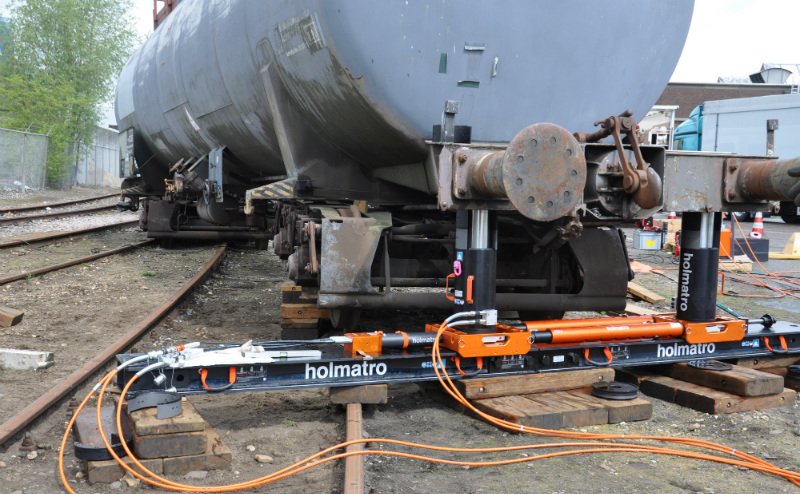
This work aims at value addition to the response in times of train derailments and accessibility to those areas which are inaccessible via rail during emergency situations, by combining the technological up-gradation and reduction in consumption of overhead time with the general principles of hydraulics; thus, contributing to the larger social cause of faster rescue and minimum train rescheduling in times of derailment in the Indian Railways. A rail-road vehicle is a vehicle which can operate both on rail tracks and a conventional road. Conventionally propulsion is through the tires, the rail wheels being free-rolling; the rail wheels are raised and lowered as needed but the authors’ design provides drive to the rail wheels for propulsion. The heavy load breakdown crane of the Indian Railways is its most important asset in Accident Response. But, the use of the existing breakdown cranes is limited only to tracks. Thus, bringing the crane to the site of the accident means travelling it over kilometres of railway lines which, in turn, means loss of response time. The design made by the authors includes the use of a hydraulic circuit for the lowering and lifting of rail and road wheels; the complete hydraulic system installed onto a convertible rail road truck provided with a breakdown crane that enables it to be operated either on road or on railway tracks, and to carry loaded or unloaded railway cars when on rail.

Learn moreThis article needs additional citations for verification.

The ČKD ČME3 is one of the longest-running and most-manufactured diesel–electric locomotives ever made.

These Pacific National-operated locos show three styles of diesel locomotive body: box cab (rear), hood unit (center) and cab unit (front).

diesel locomotive is a type of railway locomotive in which the prime mover is a diesel engine. Several types of diesel locomotive have been developed, differing mainly in the means by which mechanical power is conveyed to the driving wheels.

BENZ(hydraulics)

Active Body Control, or ABC, is the Mercedes-Benz brand name used to describe hydraulic fully active suspension, that allows control of the vehicle body motions and therefore virtually eliminates body roll in many driving situations including corneringaccelerating, and braking. Mercedes-Benz has been experimenting with these capabilities for automobile suspension since the air suspension of the 1963 600 and the hydropneumatic (fluid and air) suspension of the 1974 6.9.

ABC is only available on rear-wheel drive models. All-wheel drive models are available only with Airmatic semi-active air suspension. Production version introduced at the 1999 Geneva Motor Show on the new Mercedes-Benz CL-Class C215.

The ABC has undergone major modifications for the new S-Class: the wheel damping is now continuously adjustable, the spring strut response has been improved and the pump efficiency has been further enhanced. A digital interface connects the control unit and the sensors, while the fast FlexRay bus connects the control unit and the vehicle electronics. Processing power is more than double that of the previous system.[6]

In 2014 the new C217 S-Class Coupe introduced an update to Magic Body Control, called Active Curve Tilting.[7] This new system allows the vehicle to lean up to 2.5 degrees into a turn, similar to a tilting train. The leaning is intended to counter the effect of centrifugal force on the occupants and is available only on rear-wheel drive models

I hope to all who visit the site do like&follow

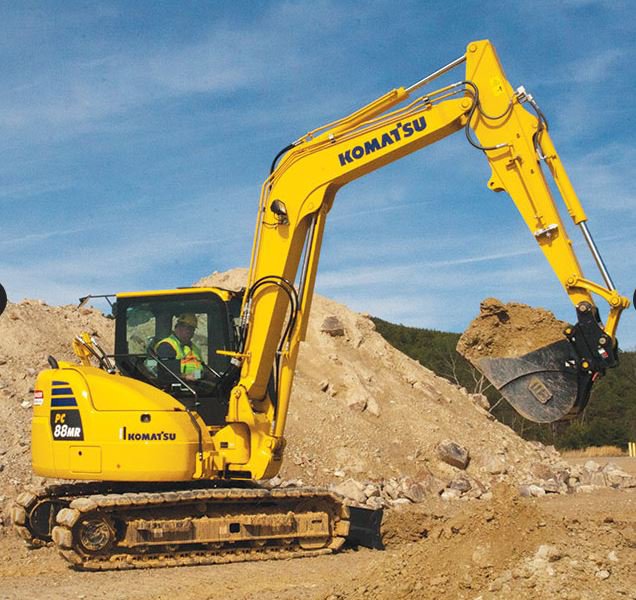
HYDRAULIC machinery

Joseph Bramah patented the hydraulic press in 1795.While working at Bramah’s shop, Henry Maudslay suggested a cup leather packing. needed] Because it produced superior results, the hydraulic press eventually displaced the steam hammer for metal forging.

Harry Franklin Vickers was called the “Father of Industrial Hydraulics”

Fluid contiminated

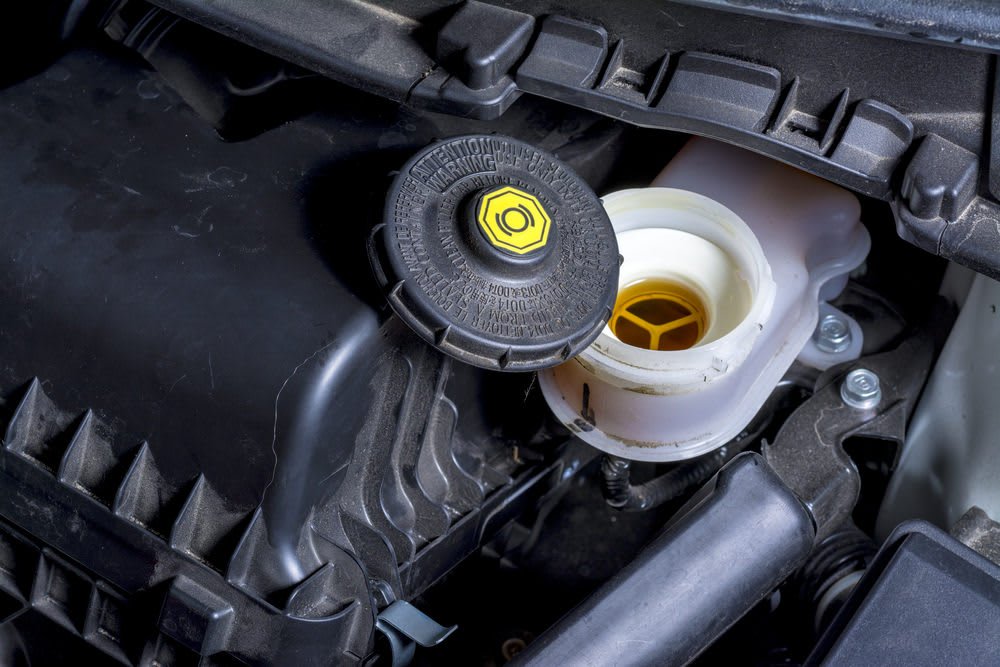
Brake fluid is a type of hydraulic fluid used in hydraulic brake and hydraulic clutch applications in automobilesmotorcycleslight trucks, and some bicycles. It is used to transfer force into pressure, and to amplify braking force. It works because liquids are not appreciably compressible.

Different Hydraulic systems

It is very sad for a man to make himself servant to a thing, his manhood all taken out of him by the hydraulic pressure of excessive business. I should not like to be merely a great doctor, a great lawyer, a great minister, a great politician I should like to be also something of a man.

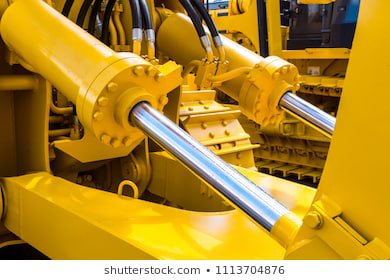
Ezy-Fit Hydraulics designs and manufactures a wide range of hydraulic cylinders for the industrial market. Tahrough a 3000 PSI design pressure industrial range and custom designed cylinders tailor-made for the application at hand.

Benedetto CastelliEdit

In 1619 Benedetto Castelli (1576 – 1578–1643), a student of Galileo Galilei, published the book Della Misura dell’Acque Correnti or “On the Measurement of Running Waters”, one of the foundations of modern hydrodynamics. He served as a chief consultant to the Pope on hydraulic projects, i.e., management of rivers in the Papal States, beginning in 1626.[29]

Blaise PascalEdit

Blaise Pascal (1623–1662) studied fluid hydrodynamics and hydrostatics, centered on the principles of hydraulic fluids. His discovery on the theory behind hydraulics led to the invention of the hydraulic press by Joseph Bramah, which multiplied a smaller force acting on a smaller area into the application of a larger force totaled over a larger area, transmitted through the same pressure (or same change of pressure) at both locations. Pascal’s law or principle states that for an incompressible fluid at rest, the difference in pressure is proportional to the difference in height and this difference remains the same whether or not the overall pressure of the fluid is changed by applying an external force. This implies that by increasing the pressure at any point in a confined fluid, there is an equal increase at every other point in the container, i.e., any change in pressure applied at any point of the fluid is transmitted undiminished throughout the fluids.

Jean Léonard Marie PoiseuilleEdit

A French physician, Poiseuille (1797–1869) researched the flow of blood through the body and discovered an important law governing the rate of flow with the diameter of the tube in which flow occurred.[30][citation needed]

In the UKEdit

Several cities developed citywide hydraulic power networks in the 19th century, to operate machinery such as lifts, cranes, capstans and the like. Joseph Bramah[31] (1748–1814) was an early innovator and William Armstrong[32] (1810–1900) perfected the apparatus for power delivery on an industrial scale. In London, the London Hydraulic Power Company[33] was a major supplier its pipes serving large parts of the West End of LondonCity and the Docks, but there were schemes restricted to single enterprises such as docks and railway goods yards.

Hydraulic modelsEdit

After students understand the basic principles of hydraulics, some teachers use a hydraulic analogy to help students learn other things. For example:

  • The MONIAC Computer uses water flowing through hydraulic components to help students learn about economics.
  • The thermal-hydraulic analogy uses hydraulic principles to help students learn about thermal circuits.
  • The electronic–hydraulic analogy uses hydraulic principles to help students learn about electronics.

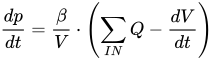
The conservation of mass requirement combined with fluid compressibility yields a fundamental relationship between pressure, fluid flow, and volumetric expansion, as shown below [34]:{\displaystyle {\frac {dp}{dt}}={\frac {\beta }{V}}\cdot \left(\sum _{IN}Q-{\frac {dV}{dt}}\right)}{\displaystyle {\frac {dp}{dt}}={\frac {\beta }{V}}\cdot \left(\sum _{IN}Q-{\frac {dV}{dt}}\right)}

Assuming an incompressible fluid or a “very large” ratio of compressibility to contained fluid volume, a finite rate of pressure rise requires that any net flow into the contained fluid volume create a volumetric change.